
Sky Blue Pink
Jul 10, 2026
"CAVU"
It’s a term aviators use to describe a certain condition of the weather they become a part of as soon as their wheels leave the ground.
It stands for Ceiling And Visibility Unlimited, and is the default condition of the sky in vast swathes of the Great American Southwest. In some regions, it’s not uncommon to have over 300 days of sunshine in a year, much of it with unrestricted visibility.
But those clear skies are often accompanied by gale-force winds, not optimal for flying. I guess things are rarely perfect, even when they appear to be ideal.
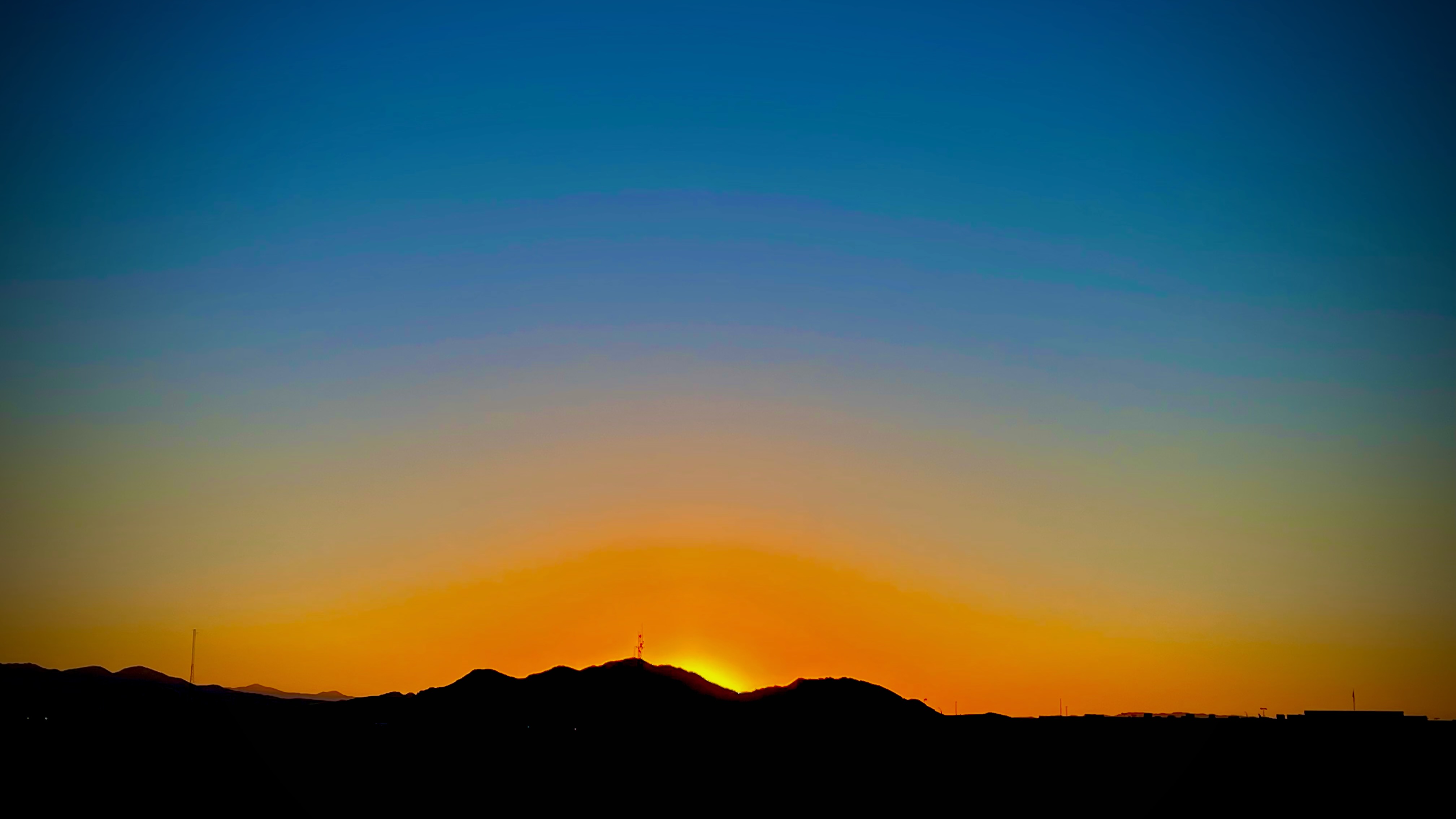
Because the skies in that part of the country are frequently preternaturally clear, there is a beautiful atmospheric condition that manifests on a regular basis. Just before the sun comes up and just after it goes down—times officially known as civil twilight—the horizon is silhouetted by a muted pink band that transitions seamlessly through lavender and into light blue:
Sky blue pink.
I am a little embarrassed to admit that I was several decades into my life before I knew that term referred to an actual, physical phenomenon.
I had heard it mentioned in a whimsical way, of course, but I didn’t directly tie it to the beauty that accompanies the rising and setting sun until I made a casual remark about how pretty the sky looked to my significant other of more than 30 years.
On one of the many long drives we used to enjoy together, we were headed west and the sun had just set. On this particular day, the sky was awash with a technicolor display: a tiny band of orange-pink over the dark purple mountains that rapidly became a large band of pink and then light blue before it faded into darkness.
I commented on how stunning the twilight sky was, she looked at me incredulously, and said, simply, “That’s sky blue pink.”
That was shortly before she left me and the Southwest to pursue clearer skies and brighter horizons.
There are advantages to the darkness that follows the sky blue pink afterglow. It may be harder to see where you're going—moving forward requires more deliberation—but the air is cool and smooth.
It behooves one to remember that the loss of beauty can bring with it a reduction in turbulence.
The darkness itself is attractive, in a film noir way. Distant lights are visible that would not have been discerned in the fullness of light. And in most situations, the darkness is not complete. After your eyes adjust, it’s still possible to make out the distant horizon, darker still against the blackening sky.
Likewise, gazing eastward in the early morning has specific benefits—psychologically and physiologically—before the sun has bleached the color from the sky, and the bright oranges of a new day become too intense to behold directly.
A friend of mine who lives in the high desert is fond of saying—especially in the intense summers—“We don’t have sunshine here, we have solar radiation.“
But between darkness and nuclear-level illumination, the light of a sunrise can actually reset your brain chemicals.
It appears that early-morning outdoor light is the strongest known environmental signal for synchronizing the brain's master circadian clock. Morning sunlight helps establish the timing of melatonin secretion roughly 14–16 hours later, improving circadian alignment, sleep timing, and daytime alertness.1
Now we have several reasons to enjoy twilight: romantic liaisons (following a walk on the beach, of course), “golden hour” photography, and stimulation of the suprachiasmatic nucleus (duh…).
The manifestation of sky blue pink is unique in our solar system; a delicate excitation of a humidity-rich atmosphere at a very specific distance from its closest star. When I see it now, I think about how lucky I am to be alive and conscious in a relatively cloudless environment.
And I remember once-upon-a-time westward drives with a cherished companion.
I am grateful for the spectacle of sunset, even as I cautiously navigate the twilight.
1Duffy JF, Czeisler CA. Effect of Light on Human Circadian Physiology. Sleep Med Clin. 2009 Jun;4(2):165-177. doi: 10.1016/j.jsmc.2009.01.004. PMID: 20161220; PMCID: PMC2717723.
Read my recent interview with Dr. Mehmet Yildiz here.
My novel, The Calling is available now in print and as an eBook.
Click here to subscribe to SHADOW & STAR, my free weekly newsletter.
To learn more about how to use these concepts or to inquire about working with me, go to the Jeff W Welsh website, subscribe to my Substack or Medium accounts or the Hardcore Happiness blog page, and follow my Instagram account for regular insights.
Borderland Radio is LIVE every Thursday night at 8 PM US Pacific Time - call in and be a part of the show!
See the replays of previous Transmissions on YouTube or Twitch.
- JWW
Subscribe to the HARDCORE HAPPINESS blog
Never miss a post, and get goodies meant only for our community!
We will never sell your info. Ever. EVER!
