Sixteen Panes of Glass: The Joy of Not Knowing
Sep 25, 2026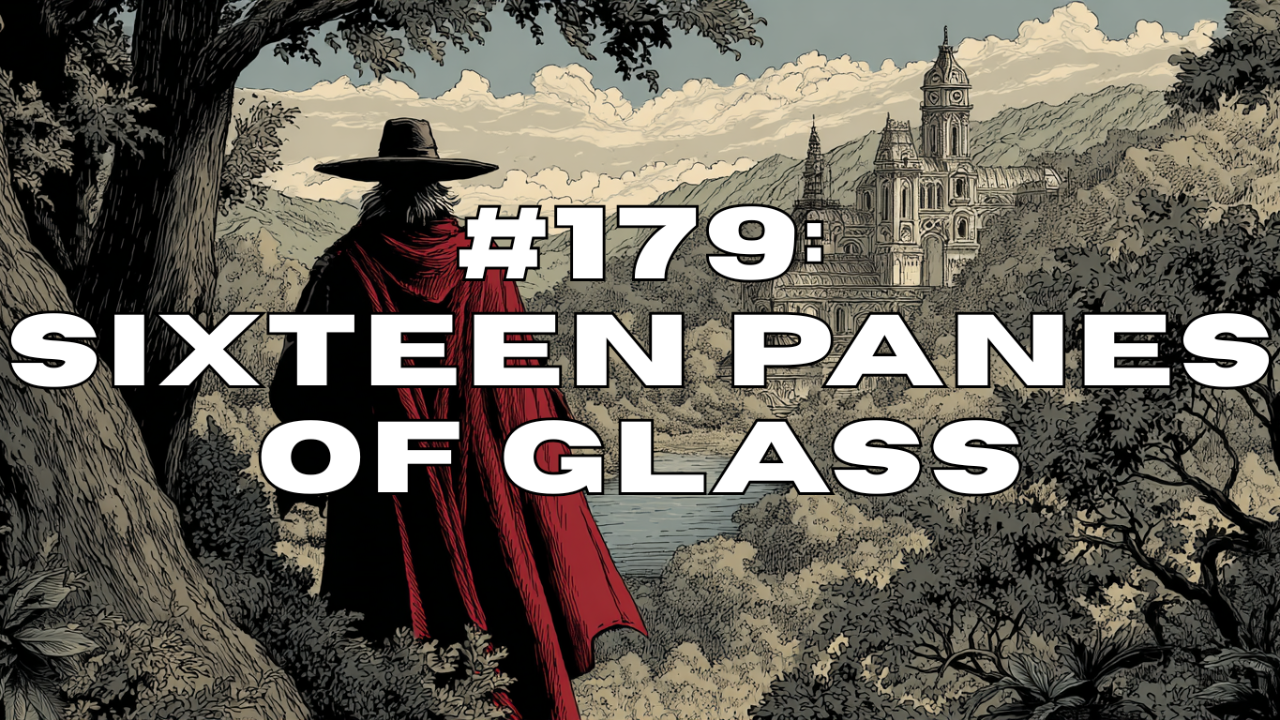
I watched the sun come up exactly due east this morning, on its way south—not for the winter, but causing it.
As the Earth orbits the sun, it does so with a slight tilt, like a basketball spinning on a finger, but at an angle, not straight up and down. This tilt is properly known as the obliquity of the ecliptic, and the amount of the tilt is denoted as ε (that’s a lower-case epsilon, in Greek).
Every planet in our solar system has an ε; none spin exactly straight up and down. Earth’s ε is pretty mild, compared to some of the other planets, at roughly 23.44º.
This makes for some interesting phenomena, like, say… seasons.
Here in the Northern Hemisphere, there are two extremes of sunlight and temperature, and two periods in between. Around December 21st, the Northern Hemisphere is tilted as far away from the sun as it is going to be. The days are short, the nights are long and the average temperature drops. We call the specific moment of maximum darkness the winter solstice, and the season around it, winter.
Solstice comes from the Latin sol, which is the sun, and sistere, which means to stand still. On the solstices, the “sun stands still” and starts back the other way, relative to the earth. From June to December, the sun appears to have been moving south. On the day of the winter solstice, it “stops” and starts back north.
Six months later, roughly June 21st—the summer solstice—the opposite is true. We in the North are tilted toward the sun, with long days, short nights and hotter temperatures, and we experience summer.
And exactly between the two extremes, twice a year, the Earth shows its middle to our star: the equator is aimed at the sun and the length of daylight is approximately the same as the length of night. These times are known as the equinoxes (meaning “equal nights”) and named for the seasons they herald: The spring or vernal equinox happens about March 20th, and the fall, or autumnal equinox happened this year on September 22nd—the day I am writing this.
So there you have it.
We have numbers and measurements and even “science-y” Greek letters. That’s all there is to it, wrapped up in a neat, safe bow of astronomy, right?
Not so fast there, Copernicus…
There is more to the equinox: The angle of the sun illuminates our world differently than it did in mid-summer. We start to feel it as the days get cooler and fall is on the way. The change of seasons affects us in ways difficult to force into statistical analysis.
The Hermetic injunction, “As above, so below” was not just metaphor. We resonate with the changes in the heavens, just as the seas move with the moon, a much lesser celestial body.
And if you can still your mind enough to stop the distractions, you can feel it.
This is basic science, not spiritual or religious by its fundamental nature, although it has informed those disciplines for millennia.
Our ancestors knew this. It was basic knowledge, handed down to every child and demonstrated through harvest and festivals, and later, ritual and rite. Temples large and small observe the procession of officers and the changing of passwords with elaborate and solemn ceremony.
Because these times matter.
And so they won’t be ignored.
It is only we moderns, technologically entangled and socially cynical, that have forgotten. Our isolation from the seasons, from nature, has rendered us soft. We no longer have to harvest and store for the coming winter; we just have highly processed food delivered because we can’t be bothered even to cook for ourselves.
We communicate with each other via the safe anonymity of electronic media; show our faces only when we think we can monetize it.
We possess access to information that makes the great libraries of Alexandria look like a small town branch library by comparison. We have near instantaneous access to the vast majority of extant information, and yet we are woefully ignorant.
And we have fallen spiritually and psychologically ill; punishment for our hubris.
In my personal and professional life, I see men and women stricken down by apathy. They suffer from an existential ennui, a reductionist outlook that has no room for joy, for wonder.
This viewpoint is born of a smug and condescending faux knowledge that says if a phenomenon is not rendered relevant by “science,” it is not worthy of our attention, brief though it may be.
Not realizing that the very nature of science is to continually be wrong, in search of better questions.
To be clear, I am challenging the sense of certainty about what measurement can tell us of meaning, not the nature of scientific inquiry.
The stance is convenient. If every human action is reduced to to synaptic neurochemistry, one needn’t worry about the actual nature of love, or the distinction between morality and legality.
That last is important, because man can change societal law, even though it conflicts with morality and the natural order, both of which are unconcerned with the base desires of humankind.
This modern day malady has no place for free will, for purpose, or meaning, and leads inevitably to Camus’ one truly serious philosophical problem.
We know everything that matters now; we have it all figured out. Turns out, in our infinite wisdom, we’ve forgotten how much we don’t know.
We’re just too damn smart for our own good.
We have become so pampered that we neglect our own health and survival. So jaded that we allow ourselves to lose track of the possibility that perhaps we don’t know everything.
Maybe our certitude that all of human experience can be reduced to inevitable programming is tantamount to our ancestors looking at the stars and thinking they were holes in a giant deer skin.
Since there is no God or gods, and we are simple accidents of “deep time”—an accidental collision of fundamental particles, the thinking goes—there’s really no reason to do anything.
And it is wholly due to the efforts of men who didn’t believe this way that we don’t have to do anything.
This is the path of least responsibility.
We have no say in our affairs, our emotions or behavior. We’re just poor, simple, quasi-sentient victims, the results of a mathematical possibility applied to organic chemistry.
We no longer have a sense of humble gratitude that we’re able to enjoy and recognize the passage of time.
We have so anesthetized our higher senses with commercialized distraction that we no longer feel the gratitude deserving of the ineffable gift of consciousness.
So we have forgotten about the seasons.
The actual turning of our world and ourselves has, for many, become an unthinking series of reflex actions: buy the plastic skeleton and pumpkins; have the Thanksgiving turkey cooked by someone else, delivered by someone else. Buy the plastic tree and meaningless plastic presents in time to make resolutions that we don’t intend to keep for a new year that we don’t really recognize.
And then move on to chocolates and plastic flowers in time for the Easter bunny.
And so it goes until we are no more.
The great tragedy is not that we cease to exist, but that we have forgotten how.
And yet, there is hope.
There are still those among us who realize that the intellectual processes of which we are so laughably proud are not the truth in toto.
That which we mistake for truth is the light of a dim candle flame, viewed through 16 panes of dirty glass.
The steps to recovery are the same they have always been; simple, direct and immediate.
A word of warning, however: the path to enlightenment will require personal responsibility.
First, take a break from the electronics. The endless dopamine quest of nonsense that you feed your mind is all programmed by a simple algorithm to keep simple people buying needless things. You already know this.
Second, touch some grass. Seriously: get outside. Look at the stars; realize you’re made of the same stuff they are. Realize we have absolutely no idea how or why. Be grateful that you can realize this.
Third, take it upon yourself to relearn how to think. Reading is not thinking. Watching short videos is not thinking. Media—social and otherwise—is not thinking.
Thinking is you, by yourself, puzzling out what actually makes sense in a world in which the vast majority of truth is hidden from us and incomprehensible if we were to find it.
It really boils down to two things:
First, realize that you don’t know everything. In fact, you don’t really know anything. So to make absolute conclusions based on ignorance is, well… ignorant.
Second—and this is the more difficult of the two—allow yourself to feel again.
Remember what it was like when you were a child and the world was full of wonder and joy. Realize that it is merely decades of conditioning that have led you to believe that fun is somehow unworthy of being an adult.
Be still, be humble, and relearn what you already knew: that the world outside of us is consequential, that we are consequential, and that we can feel the connection.
Happy equinox.

Read my recent interview with Dr. Mehmet Yildiz here.
My novel, The Calling is available now in print and as an eBook.
Click here to subscribe to SHADOW & STAR, my free weekly newsletter.
To learn more about how to use these concepts or to inquire about working with me, visit the Jeff W Welsh website, subscribe to my Substack or Medium accounts or the Hardcore Happiness blog page, and follow my Instagram account for regular insights.
Borderland Radio is LIVE every Thursday night at 8 PM US Pacific Time - call in and be a part of the show!
- JWW
Subscribe to the HARDCORE HAPPINESS blog
Never miss a post, and get goodies meant only for our community!
We will never sell your info. Ever. EVER!
