
Separate Time: A Mindfulness Paradigm for Modern Life
May 22, 2026
We have all heard the advice: “Live in the present.” “Now is the only time you have.” I myself regularly extol the virtues of mindful living in the present.
This week, I want to make a case for how to keep your thoughts centered on present action, and why that is a sound strategy, using examples ranging from from math to philosophy, neuropsychology to complexity theory.
First, a reminder of the oft-repeated and obvious:
The past is gone, and you can have no influence on it. The future has not yet manifested, and any influence you may be able to exert in the future is gained by acting in the present.
Which brings us back to the central point: the only agency you have in regards to time is in the present moment.
It is critically important that you learn to train your mind to clearly differentiate past, present and future. This is more difficult than it seems.
We tend to let past events occupy an inordinate amount of our consciousness; we resent, regret and ruminate over our past actions and reactions (“I should have said…”) The best strategic use of past events is to retain the lessons we have learned. This is the primary reason we have memory in the first place.
It is also important to realize that we spend a great deal of time worrying about the future. Considering the future to the extent that we can stack probability in our favor is useful and necessary. But entertaining vague fears and unfounded anxiety is damaging to your health, and distracts you from present thoughts and actions.
To get a grasp on how to mindfully function in the present, intentionally compartmentalize your mindset. Consciously separate the past from the present, and the present from the future.
Take stock of your thoughts throughout the day. Don’t try to control them at first, but do write them down.
The most powerful tool in your arsenal is the ability to separate your thoughts around what has already happened (“was”), what might happen “(will”) and what you would like to see happen (“want”).
If you are like almost all of the clients and students with whom I have worked, you will be surprised at the amount of mental energy you spend in the was and will.
Remember you have no control over what was, and limited ability to influence what will be.
Once you have a good idea of where your mind wants to go when left to its own devices, you can start to consciously and intentionally focus your mental energy in the present, where it can help you.
Leave past events behind, meaning don’t assign your energy to it, in terms of regret or revenge. Banish any shame and anger you are carrying. Let the past be solely a storehouse of cherished memories and lessons learned.
Do not let the future become a black hole for your energy in terms of worry, especially about things that you cannot control. That mental effort is best used to think and act in the present, with the goal of having some say about what might happen in the future.
Now you have a plan on how to go about freeing up your mental energy and focusing your mindset on the present. Here’s a look at why that matters so much.
Newton and Leibniz, when they independently formulated calculus, realized that position could be understood as the accumulation of countless tiny changes over time. This led to the fundamental formula for integration:
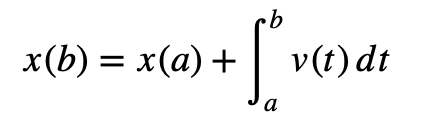
Simply put, an object’s location is the cumulative result of countless tiny changes.
So it is with us.
This basic insight has been around for centuries. Heraclitus spoke of rivers and flow. Kierkegaard described movement and existential leaps. Heidegger framed human existence in terms of projection and becoming. Modern cognitive science invokes attractor landscapes, and complexity theory describes phase transitions and emergent states.
Of these analogies, the last—attractor landscapes—is perhaps the most powerful. The concept, as applied in cognitive science and neuroscience, implies something profound:
Repeated trajectories reshape the landscape itself.
That probably warrants a slow, careful re-reading.
Beyond the familiar Hebbian principle that “neurons that fire together wire together,” this is a systems-level understanding that helps explain how repeated actions—actions that can only take place in the present, of course—gradually shape who and what we become.
Such is the power of habits: we are the cumulative result of what we repeatedly practice.
Write down, in great detail, what you would like to see happen in your future. Next to that, list the thoughts and actions that are your best understanding of what is most likely to take you in that direction. Finally, do the things you have identified, every day. Make your newly identified actions the backbone of your daily life.
Let’s use a common and relatively simple (in concept, anyway) example: Imagine that you are overweight, by your own standards.
First, write down how often you might feel regret for past decisions and how much energy might go into regret, shame, self-deprecation or anything else that is rooted in the was.
Then consciously and intentionally drop all that baggage. You’re about to change it anyway.
Next, write another list that details how much time and energy you spend worrying about what might happen in the future regarding your health, reputation, ability to enjoy life, and anything else that sits firmly in the will category.
Realize that this energy can be put to much better use formulating a plan to control the things you can control, and then acting on those plans. Maybe, for our hypothetical case, you decide that your best bet to create the future you want is to exercise and eat more healthily.
Finally—and most importantly—do the things you have identified.
Take action.
Every day, without fail.
Without excuses.
Create lasting habits of gratitude, optimism, and focused, carefully considered actions. Repeat them so consistently that you can’t not do them.
You are the only person who can take the small, repeated steps that lead to the future you want.
My novel, The Calling is available now in print and as an eBook.
Click here to subscribe to SHADOW & STAR, my free weekly newsletter.
To learn more about how to use these concepts or to inquire about working with me, go to the Jeff W Welsh website, subscribe to my Substack or Medium accounts or the Hardcore Happiness blog page, and follow my Instagram account for regular insights.
- JWW
Subscribe to the HARDCORE HAPPINESS blog
Never miss a post, and get goodies meant only for our community!
We will never sell your info. Ever. EVER!
